 PhD student @ Northeastern University
I am a second-year Ph.D. student in Computer Science at Northeastern University (China), supervised by Prof. Yanfeng Zhang.
I’m interested in building distributed and parallel graph processing systems. I am also interested in GPU-accelerated data management.

Warning
Problem: The current name of your GitHub Pages repository ("Solution: Please consider renaming the repository to "
http://".
However, if the current repository name is intended, you can ignore this message by removing "{% include widgets/debug_repo_name.html %}" in index.html.
Action required
Problem: The current root path of this site is "baseurl ("_config.yml.
Solution: Please set the
baseurl in _config.yml to "Education
-
Northeastern UniversityPh.D. StudentSep. 2024 - present
-
Northeastern UniversityM.S. in Computer ScienceSep. 2022 - Jul. 2024
-
Northeastern UniversityB.S. in Computer ScienceSep. 2018 - Jul. 2024
Honors & Awards
-
National Encouragement Scholarship of China2020
-
The Runner-up in China’s first CCF Graph Computing Challenge2023
-
The School-level scholarships2021, 2022, 2023
Selected Publications (view all )
EvoRAG: Making KG-based RAG Automatically Evolve through Feedback Backpropagation
Zhenbo Fu, Yuanzhe Zhang, Qiange Wang, Hao Yuan, Yuehao Xu, Enze Yi, Yanfeng Zhang, Ge Yu
IEEE International Conference on Data Engineering 2027
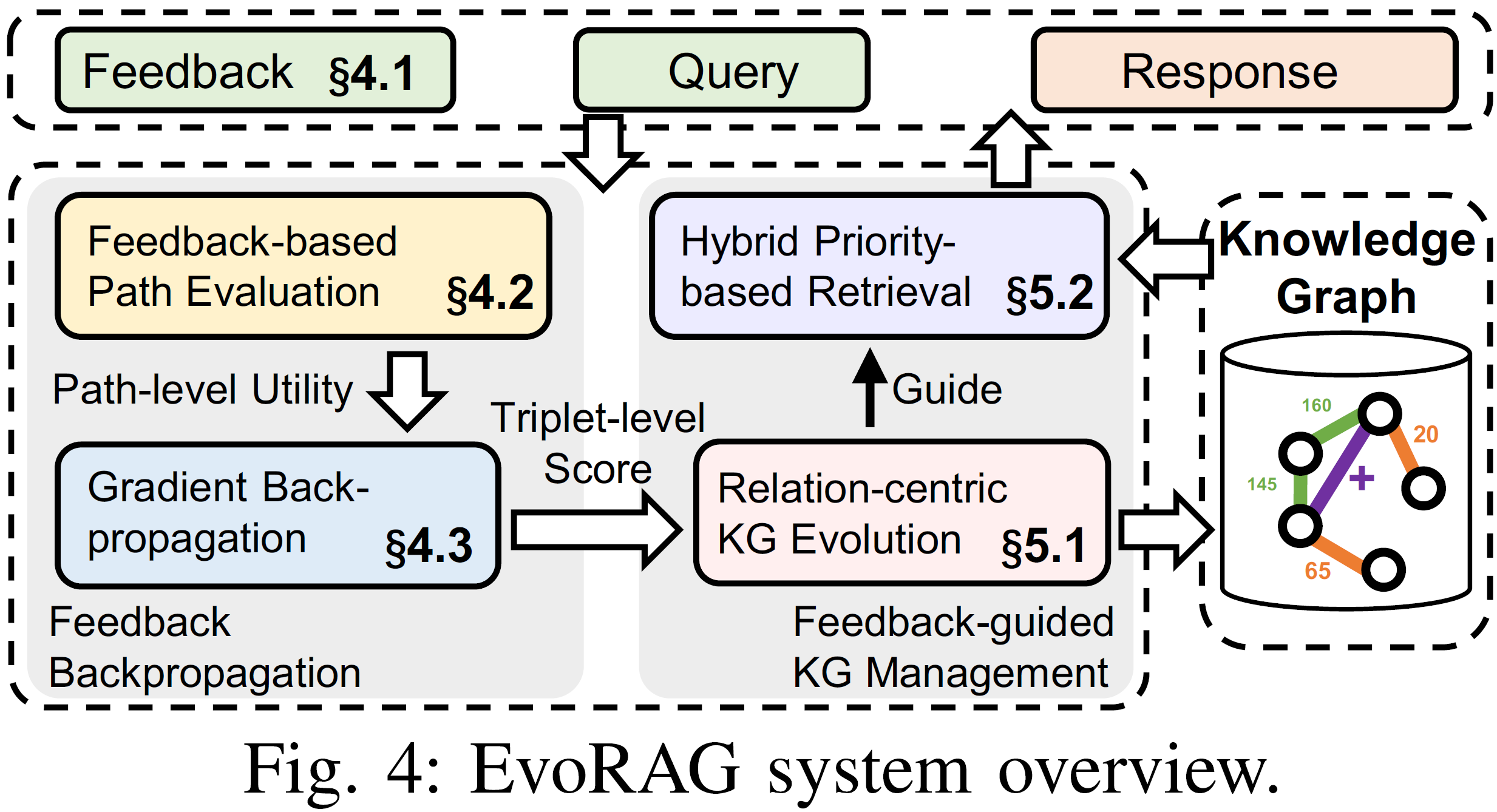
In this work, we propose EvoRAG, a self-evolving KG-RAG framework that leverages the feedback over generated responses to continuously refine the KG and enhance reasoning accuracy. EvoRAG introduces a feedback backpropagation mechanism that attributes feedback to retrieved paths by measuring their utility for response and propagates this utility back to individual triplets, supporting fine-grained KG refinements towards more adaptive and accurate reasoning. Through EvoRAG, we establish a closed loop that couples feedback, LLM, and graph data, continuously enhancing the performance and robustness in real-world scenarios. Experimental results show that EvoRAG improves reasoning accuracy by 7.34% over state-of-the-art KG-RAG frameworks.
NeutronJittor: Efficient CPU-GPU Memory Management for GNN Training with Jittor
Shizhan Lu *, Zhenbo Fu *, Qiange Wang, Yanfeng Zhang, Yuehao Xu, Xin Ai, Zhewei Wei, Ge Yu (* equal contribution)
Fundamental Research 2026
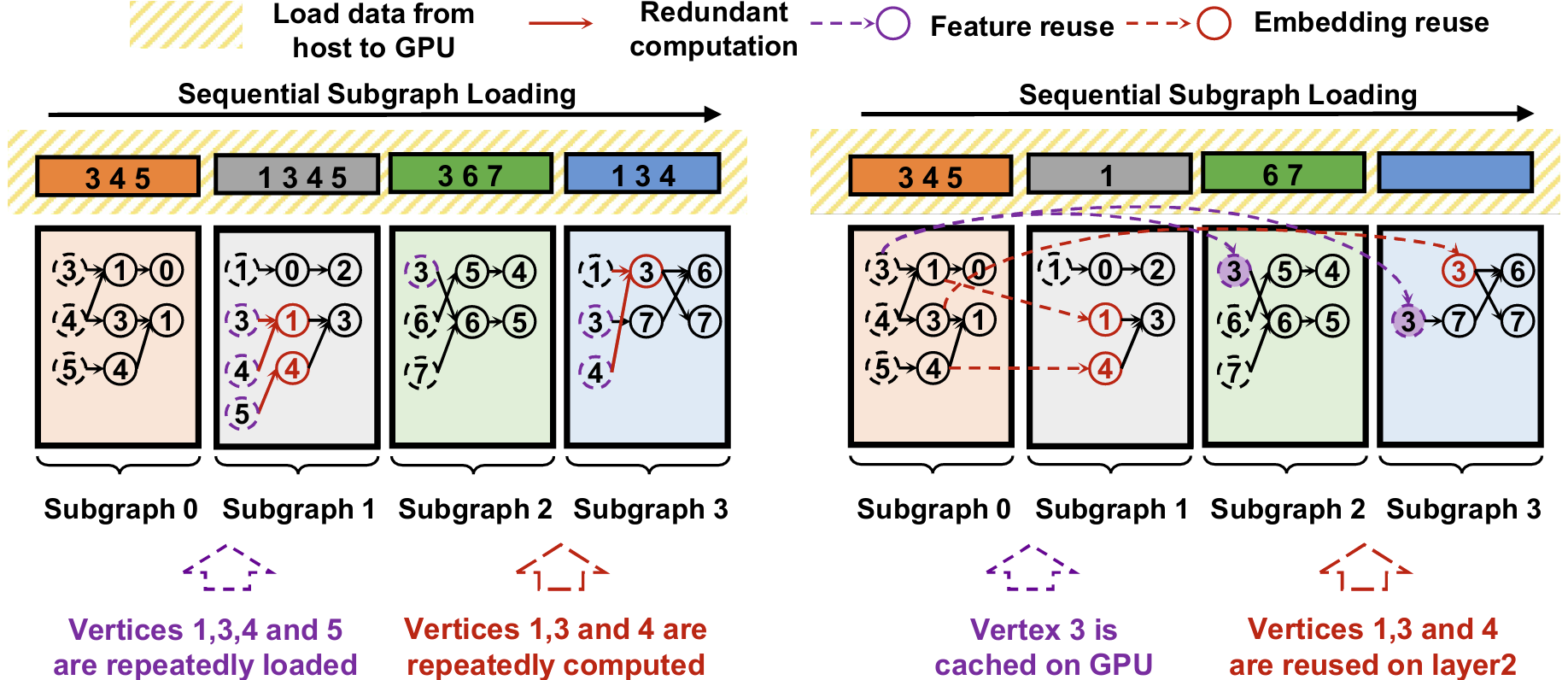
Full-graph GNN training often provides better accuracy and stability, but its large memory footprint and irregular graph access patterns make user-transparent memory management on GPUs inefficient. We propose NeutronJittor, a GNN training system that reduces redundant computation through embedding reuse across shared vertices within an epoch and lowers CPU–GPU data movement with a spatial–temporal-aware scheduler that keeps high-priority vertex data on the GPU.
NeutronCloud: Resource-Aware Distributed GNN Training in Fluctuating Cloud Environments
Mingyi Cao, Chunyu Cao, Yanfeng Zhang, Zhenbo Fu, Xin Ai, Qiange Wang, Yu Gu, Ge Yu
Very Large Data Bases (VLDB) 2026
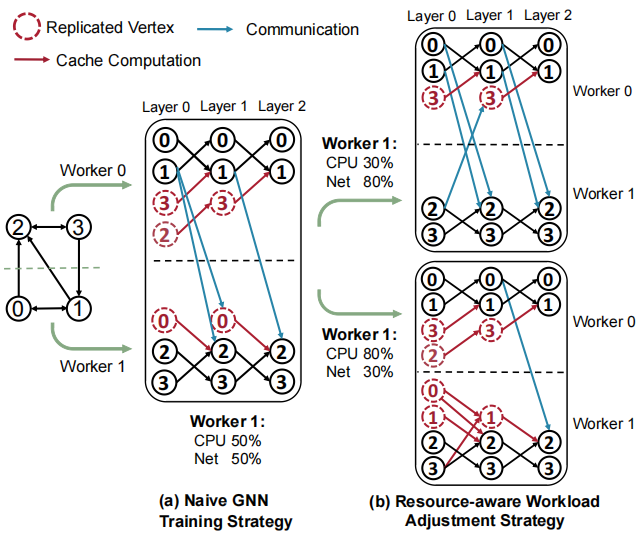
In this paper, we propose NeutronCloud, a system designed for efficient GNN training in cloud environments. First, we adopt a resource-aware workload adjustment strategy. It builds on hybrid dependency handling by obtaining dependency information through both local computation and remote communication. During training, it dynamically adjusts the ratio between locally computed and remotely fetched dependencies based on each worker's available resources, ensuring workload-resource alignment. Second, we employ a dependency-aware partial-reduce approach reusing historical vertex embeddings and skipping the stragglers during gradient aggregation to address extreme resource fluctuations that cause some workers to lag significantly behind others in the cluster.
NeutronTask: Scalable and Efficient Multi-GPU GNN Training with Task Parallelism
Zhenbo Fu, Xin Ai, Qiange Wang, Yanfeng Zhang, Shizhan Lu, Chaoyi Chen, Chunyu Cao, Hao Yuan, Zhewei Wei, Yu Gu, Yingyou Wen, Ge Yu
Very Large Data Bases (VLDB) 2025
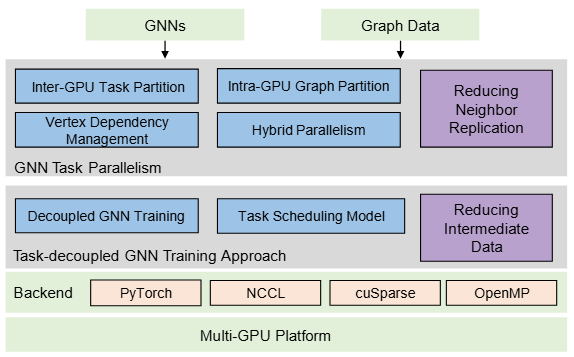
In this work, we propose NeutronTask, a multi-GPU GNN training system that adopts GNN task parallelism. Instead of partitioning the graph structure, NeutronTask partitions training tasks in each layer across different GPUs, which significantly reduces neighbor replication.

NeutronRAG: Towards Understanding the Effectiveness of RAG from a Data Retrieval Perspective [Demo]
Peizheng Li, Chaoyi Chen, Hao Yuan, Zhenbo Fu, Xinbo Yang, Qiange Wang, Xin Ai, Yanfeng Zhang, Yingyou Wen, Ge Yu
Proceedings of the International Conference on Management of Data (SIGMOD) 2025
Existing RAG tools typically use a single retrieval method, lacking analytical capabilities and multi-strategy support. To address these challenges, we introduce NeutronRAG, a demonstration of understanding the effectiveness of RAG from a data retrieval perspective. NeutronRAG supports hybrid retrieval strategies and helps researchers iteratively refine RAG configuration to improve retrieval and generation quality through systematic analysis, visual feedback, and parameter adjustment advice.